Fleet Coordination and Lifelong Pathfinding

Published research and system development

Logistics fleets must repeatedly plan routes as robots receive new destinations. Narrow aisles make this difficult: robots cannot easily pass one another, and short planning horizons can overlook conflicts farther along a corridor.

  • Topological maps: represent the operating environment as connected waypoints and lanes, with corridor structure incorporated into path planning.
  • Anytime planning: find an initial route set quickly, then improve congested portions while computation time remains.
  • Corridor-aware conflict resolution: use Corridor-CBS, a conflict-based search method, to reduce unnecessary search when agents compete for narrow passages.
  • Fleet integration: connect route coordination with task execution and robot-state updates in a fleet management system (FMS).

The 2023 study evaluates lifelong pathfinding in warehouse and railway scenarios, reporting throughput and planning success under the tested conditions. Current system work develops fleet-management interfaces and distributed coordination for logistics applications.
▶ Watch demo
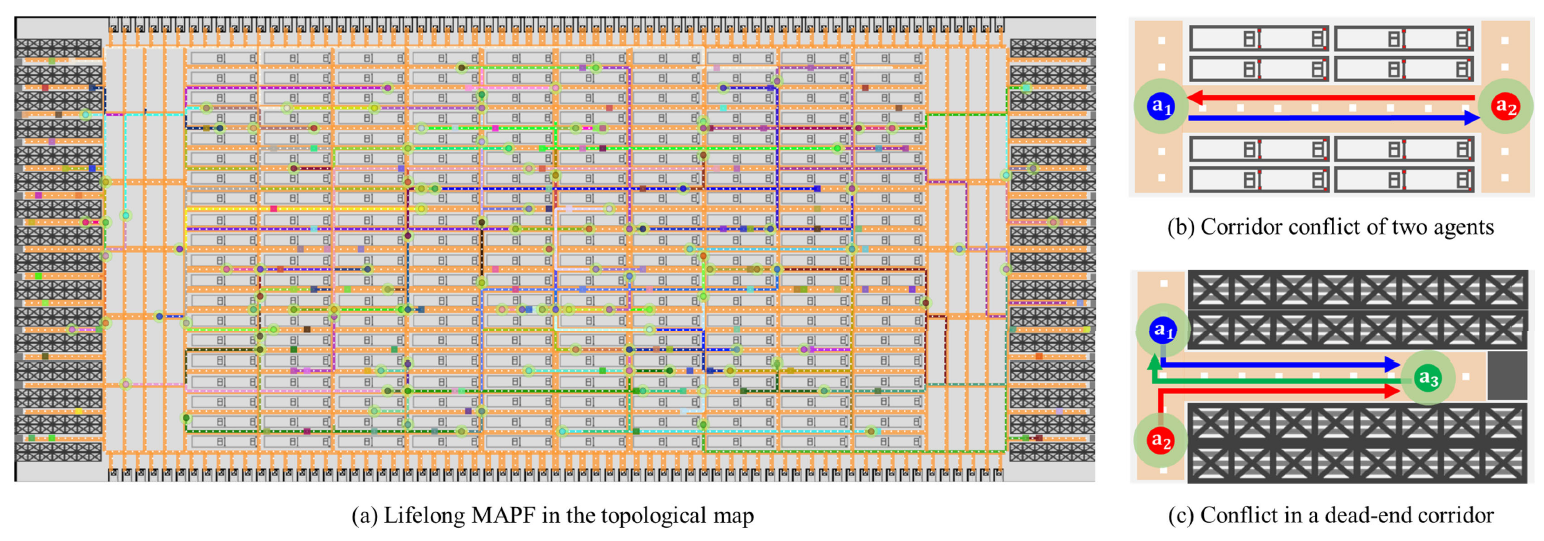
Topological warehouse map with robot routes and diagrams of opposing traffic and dead-end corridor conflicts
Lifelong pathfinding on a topological warehouse map, with examples of opposing traffic and conflicts in dead-end corridors.

Decentralized Pathfinding with Shared Guidance

Ongoing research

A robot acting only on nearby observations may avoid immediate conflicts while moving into congestion elsewhere in the fleet. We investigate how lightweight shared information can improve local decisions without requiring a centralized planner to choose every action.

  • Learned local decisions: train decentralized navigation policies through imitation learning for multi-agent pathfinding (MAPF).
  • Sector-level guidance: periodically share coarse information about congestion across regions of the environment.
  • Selective coordination: study when shared guidance is useful and how frequently it should be updated.
  • Evaluation focus: compare throughput, task completion, communication requirements, and planning cost across fleet sizes and congestion levels.

This direction explores the balance between local autonomy and fleet-wide coordination. Its objective is to reduce the information and computation needed for effective multi-robot navigation; comparative performance remains an evaluation target.

Simulation of decentralized multi-agent navigation.

Online Multi-Task Pickup and Delivery

Published research

In order-picking scenarios, a robot may collect items for several orders before returning to a delivery location. Efficient allocation must account for payload limits and the complete sequence of pickup locations, rather than assigning each order independently.

  • Capacity-aware task groups: combine orders that a robot can complete within its carrying capacity.
  • Route-aware grouping: evaluate candidate additions by their extra travel distance using traveling-salesperson-problem (TSP) reasoning.
  • Online updates: revise queued task groups as new orders arrive.
  • Parallel processing: maintain task groups while robots move, with a separate pathfinding module resolving route conflicts.

The 2025 study evaluates service time, makespan, and computation cost in Kiva-style warehouse and sorting-center simulations. Its efficient variant limits candidate insertion calculations to newly added targets, reducing repeated route computation.
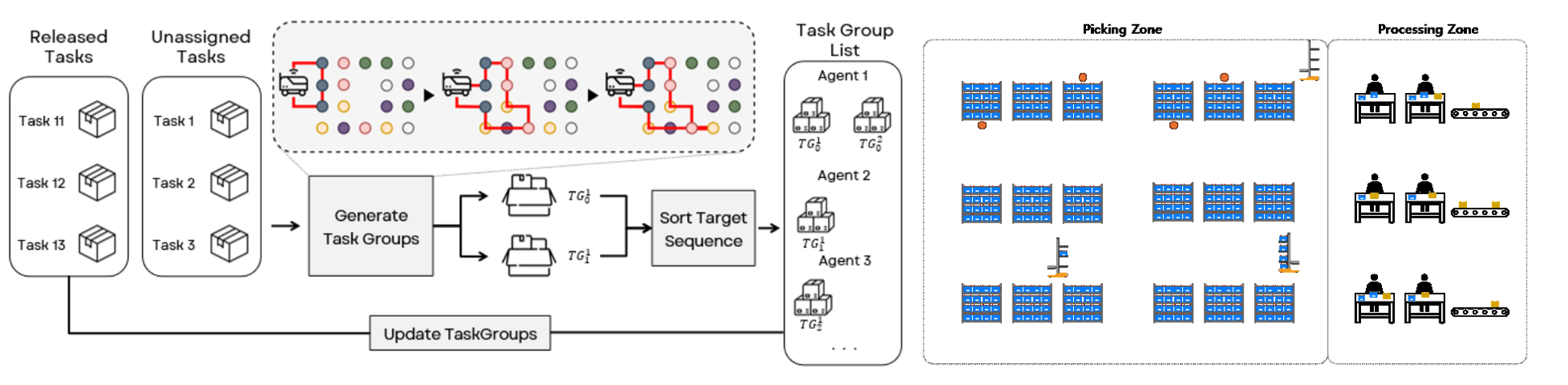
Task-group generation and update workflow beside warehouse and sorting-center simulation views
Task-group generation and updates, alongside warehouse and sorting-center simulation scenarios.

Language-Guided Planning and Localized Recovery

Accepted to Findings of EMNLP 2026

Long-horizon instructions can require many robots and interdependent actions. As plans grow, a single planner must track increasing amounts of state, and one failed action may interrupt work that does not depend on it.

HiP-LR organizes planning into a hierarchy with a central large language model (LLM) agent and local agents assigned to dependency-isolated groups.

  • Hierarchical planning: separate global task organization from detailed planning within each group.
  • Explicit dependencies: use Planning Domain Definition Language (PDDL) representations to identify relationships between actions.
  • Localized recovery: replan the affected group after a failure while independent groups can continue executing.
  • Failure evaluation: assess task completion and replanning on MAP-THOR and the failure-injection benchmark RECAP-THOR.

This work studies recovery during simulated multi-robot tasks, including failures caused by unavailable manipulation actions and changed scene conditions.

Simulated multi-robot task execution and recovery after a localized execution failure.
← Back to Research